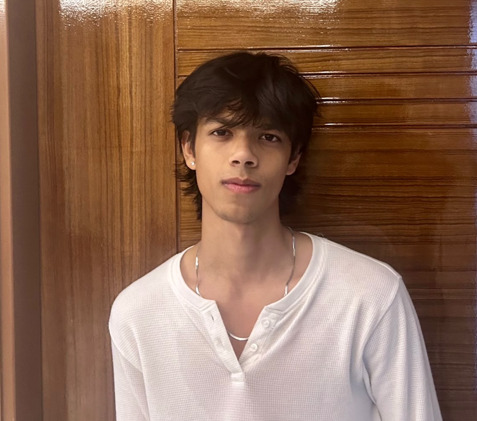
Arnav Kumar Lal Download CV

Arnav Kumar Lal

MECHANICAL ENGINEERING

I am a pre-final year mechanical engineering undergraduate at NSUT, New Delhi. My work is structural and thermal analysis, computational fluid dynamics, and the manufacturing systems that turn a model into a part. Every entry on this page names the organisation it was done for and carries the document that proves it.

Arnav Kumar Lal
Telephone
+91 84473 69293
LinkedIn
in/arnavkumarlal
Based in
New Delhi, India
Programme
B.Tech Mechanical, NSUT, 2024 to 2028
Open to
Internships, design and analysis commissions, research collaboration

What I do and what I use

I design in SolidWorks and AutoCAD, analyse in ANSYS, SimScale and MATLAB, and check the result against first principles before I trust it. The list below is limited to software and methods I have used on the work described further down this page.

Engineering software
SolidWorks, AutoCAD 2D and 3D, Fusion 360, ANSYS Mechanical, SimScale, MATLAB, Python, LibreCAD, OrcaSlicer, UltiMaker Cura, Simplify3D, Microsoft Excel
Design and analysis
Finite element analysis, computational fluid dynamics, geometric dimensioning and tolerancing, thermodynamic modelling, design for manufacturing, topology optimisation, first-principles stress and thermal analysis, metrology
Manufacturing and process
Assembly line logistics, parts and inventory control, materials supply chain, FIFO audit and dock management, lean principles, fused deposition modelling operations, reverse engineering, statistical quality control, merit indexing
Standards
ASME Y14.5, ASHRAE 55, ASHRAE 62.1, ASHRAE 15, IS 3103
Research and writing
Metal matrix nanocomposites, technical report writing, research methodologies in data science and artificial intelligence, academic publishing and dissemination

Where the work was done

Five positions, most recent first. Figures come from the reports submitted to each organisation, and those reports sit at the end of each entry. Select any image to see it full size.

May 2026to presentHybrid

Undergraduate Research Fellow

Research Department of Mechanical Engineering, NSUT, New Delhi

I study metal matrix nanocomposites under faculty supervision, with Abhishek Tevatia and Sanjay Gupta. Using representative volume element finite element analysis in SolidWorks and ANSYS, I independently verified a stress concentration factor of 1.999 plus or minus 0.001 across nanoparticle volume fractions of 0.5 to 5 per cent, which matches the analytical limit predicted by Eshelby.

I then built a twelve-parameter XGBoost surrogate model with SHAP attribution, coefficient of determination 0.96, that feeds the finite element stress concentration factor into fatigue life prediction. The model shows that particle agglomeration amplifies predicted life by a factor of three, a cubic response rather than the linear one usually assumed.

Fig. 1 Representative volume element, mesh and geometry
Fig. 2 Stress field around the embedded particle
Fig. 3 Predicted fatigue life against volume fraction
Metal matrix nanocomposites paper Abstract, one page. Full manuscript under review Download PDF

May 2026to August 2026Onsite

Junior Mechanical Design Intern

3D Paradise Technologies LLP, New Delhi

I handled parts from enquiry to dispatch for clients in defence, medicine, research, manufacturing and rapid prototyping, in India and abroad. That covered ideation, reverse engineering from physical samples, modelling in SolidWorks and Fusion 360, slicing in Simplify3D and OrcaSlicer, printer calibration, printing, post-processing and dimensional checking.

I also wrote an automated batch slicing pipeline. It drives the OrcaSlicer command line interface from Python using Trimesh, NumPy and openpyxl, returns the mass and volume of every STL in a folder in one pass, and writes the result to an Excel quotation sheet. I kept iterating on infill profiles, material variants and support configurations to hold production accuracy.

Fig. 4 Printed assembly, post-processed
Fig. 5 Printer floor, 3D Paradise
Letter of recommendation Issued by the founder, August 2026 Download PDF

May 2026to July 2026Onsite

Summer Research Intern

Solid State Physics Laboratory, Defence Research and Development Organisation, New Delhi

My first assignment was a centralised heating, ventilation and air conditioning system with sub-zero refrigeration for a hypothetical three-floor mixed-use building of 26 tons refrigeration, combining a supermarket, residential floors and a pharmaceutical cold room. I ran seasonal psychrometric analysis, calculated heat load by the cooling load temperature difference method to a peak of 90.4 kW, selected a six-row cooling coil at a bypass factor of 0.10, sized two-stage R-32 compression from a compression ratio of 9.82 down to two stages of 3.1, and closed with an annual energy figure of 257,127 kWh under ASHRAE 55, 62.1 and 15.

My second assignment was structural. I ran SIMP topology optimisation on thin-walled AISI 1020 components in SolidWorks, identified the critical load paths and removed 40 per cent of the mass while holding stress and displacement inside limits. I extended the method to thermo-structural analysis of an SS316 liquid nitrogen vessel at minus 165 degrees Celsius and 200 psi, where peak von Mises stress at the nozzle to sphere junction was 1,049 MPa. A multi-location fillet cut that peak by 5.4 per cent and raised the factor of safety from 1.11 to 1.18.

Fig. 6 Building modelled for the load calculation
Fig. 7 Optimisation constraints and material distribution
Training certificate Six weeks, HVAC system design and thin-walled components Download PDF
HVAC and refrigeration design report Seven pages, load calculation to energy analysis Download PDF
Topology optimisation report Four pages, lightweight fixture study Download PDF
Cryogenic pressure vessel report Eight pages, thermo-structural FEA validation Download PDF

December 2025to January 2026Onsite

Winter Internship Trainee, Parts and Logistics Control

Honda Cars India Limited, Tapukara, Rajasthan

My project was titled improving storage and safety efficiencies on the gemba. I worked on part logistics and parts chasing with the mechanical, electrical and systems teams, and spent time on the floor with fabrication, CNC machining, wiring, and high and low pressure die casting. My technical study for the department was on automatic and manual machine handling equipment.

The main task was a stacktainer storage deficit across a warehouse area of 300 by 8 metres. The revised layout raised the unit count by 28.6 per cent while the unpacking area lost only 7.16 per cent. Alongside that I ran a FIFO audit across the dock bays that found parts delayed by up to 253 days, and measured milkrun truck packing efficiency, which ranged from below 35 per cent to above 85 per cent.

Fig. 8 Stacktainer dimensions and proposed layout
Fig. 9 FIFO audit worksheets
Fig. 10 Tapukara plant
Internship certificate Parts and Logistics Control department Download PDF

The project report itself is internal to Honda Cars India and is not published here.

August 2025to presentOnsite

Mechanical Designer and Powertrain Engineer

Team Daedalus Racing, NSUT, formerly NSIT Motorsports

I develop a competition all-terrain vehicle with the team, using first-principles stress, strain, thermal, tolerance and cost analysis, three-dimensional CAD in SolidWorks and finite element analysis in ANSYS. Rollover impact analysis on the 280 kg vehicle at a drop height of 3 metres gave an impact force of 3,579.33 N, peak stress of 212.3 MPa and a factor of safety of 2.898, clearing the frontal, side and rear margins by 137, 106 and 88 per cent. The team took All India Rank 2 in the combustion category and nine competition awards.

Separately, and on my own time, I modelled core subsystems from scratch to learn them properly: a double wishbone suspension, a gearbox differential, an inline four engine with its piston, crankshaft and connecting rod details, the chassis subframe and an AISI 4130 roll cage.

Fig. 11 Vehicle assembly in SolidWorks
Fig. 12 Roll cage space frame
Fig. 13 The team at the event

Work done outside a position

One study that extends a published paper, and one paid commission for a civil engineering client.

Independent studySolidWorks Flow Simulation

Heat sink thermo-structural analysis and design optimisation

Two-phase study extending Abbas, 2024, on longitudinal rectangular fins

I designed a six-fin chord-array heat sink on a 120 mm copper base in SolidWorks and ran conjugate computational fluid dynamics at an inlet velocity of 3 m/s. The simulation returned a convective heat transfer coefficient of 25.04 W per square metre per kelvin against the 15 W per square metre per kelvin normally assumed by hand, an underestimation of 67 per cent that changes the design conclusion.

Adding staggered 3 mm perforations cut thermal resistance by 4.3 per cent while removing only 0.86 per cent of the fin volume. Coupling the thermal result into a structural run gave a root stress of 22 MPa, which is within limits for the material.

Fig. 14 Temperature distribution, phase one geometry
Fig. 15 Perforation scheme and constraints
Heat sink analysis report Nine pages, both phases with the full result set Download PDF

Freelance commissionSolidWorks, Fusion 360

Industrial shed model and fabrication drawing set

Private client, civil engineering

I produced the complete SolidWorks and Fusion 360 model and a ten-sheet fabrication drawing set for a mono-pitch steel shed measuring 47,910 by 25,598 mm. The structure uses twelve portal frames on 152 by 152 by 6 mm mild steel square hollow section columns, with Pratt pattern trusses in 76.2 by 76.2 mm square hollow section at a midspan depth of 762 mm.

The roof is 0.5 mm aluminium and zinc coated sheet, with eight turbo-ventilators referenced to IS 3103 in a four by two grid. All member sizing followed the requirement set by the client's civil engineer. My work was the modelling, the detailing and the drawing set.

Fig. 16 Shed isometric with roof sheeting
Fig. 17 Portal frames and roof structure
Fabrication drawing set Ten sheets, A2 landscape Download PDF

Experience outside engineering

Work that is not mechanical but taught me things the drawing board does not: representing an institution abroad, and running a small business at fourteen.

June 2025One monthSingapore

International Delegate

Singapore Model United Nations, National University of Singapore

I was selected from more than 800 candidates to represent NSUT, and by extension India, at Singapore Model United Nations 2025, held at the National University of Singapore on a college-funded place. I sat in the World Trade Organisation committee, where the work was reading fast, negotiating in the room and defending a position under cross-examination.

Fig. 18 In committee, NUS
Fig. 19 The delegation at NUS
Fig. 20 Campus marker, NUS
Delegate certificate Singapore Model United Nations 2025 Download PDF

November 2020to November 2021Remote

Founder

MacroThink

MacroThink was a small platform I started in ninth grade, selling video editing, Google Forms, Sheets and Slides work, document and presentation production, and general technical problem solving. Customers were mostly students and small channels, and the work included YouTube edits, thumbnails, channel banners and profile pictures.

I ran the whole line, from design through quality assurance to delivery. As demand grew I brought on juniors and friends and delegated work to cut turnaround, and I handled the marketing that brought customers in. It ended the year it started, but it finished small and profitable.

Fig. 21 Service and price list
Fig. 22 Brand and company description

Where I studied

One degree in progress, one summer school abroad, and the school that ran before both.

August 2024to 2028New Delhi

Bachelor of Technology, Mechanical Engineering

Netaji Subhas University of Technology, New Delhi

I was admitted through JEE Main 2024 at the 96th percentile and I am in my third year. Outside the syllabus I have spent more than two years with The Debating Society of NSUT, and my coursework carries into the research fellowship and the racing team described above.

Fig. 23 University entrance
Fig. 24 Campus, NSUT

June 2025to July 2025London

Summer School, The Ethics of Data and Artificial Intelligence

The London School of Economics and Political Science

I spent the summer at LSE on the summer school programme and finished with a grade of A minus. The course covered research methodology and the ethical questions that come with data and artificial intelligence, and it is where I learned to write and defend an argument to an academic standard.

Fig. 25 In session, LSE
Fig. 26 Campus, LSE
Summer school certificate Grade A minus, signed by the academic director Download PDF

to 2024New Delhi

Senior Secondary

St. Francis de Sales Senior Secondary School, Janakpuri, New Delhi

I served on the student leadership squad for three consecutive years: Sub Junior Prefect in 2018, Junior Prefect in 2019, and Senior Vice Head Boy in 2020. The school issued a certificate of service for the last of those, and the habit of speaking in front of a hall started there.

Fig. 27 Addressing the assembly
Fig. 28 Certificate of service, Vice Head Boy

Courses, competitions and simulations

The first seven items below travel together in one certificate file, in that order. The Arizona State specialisation is still in progress. The case study that won SpaceCon 2025 is published in full beside the certificates.

  1. AutoCAD Essentials

    CADD Centre, Janakpuri. Forty-one hours, 2D, 3D and isometric drafting

  2. Complete GD and T with manual designs and SolidWorks

    Udemy. Thirty-two and a half hours, August 2025

  3. FEM, linear and nonlinear analysis with post-processing

    Coursera guided project

  4. CFD simulation through a centrifugal pump

    Coursera guided project

  5. Operations Industrial Engineer job simulation

    Siemens, through Forage. February 2026

  6. Interstellar Insights case study competition

    SpaceCon 2025. First place, February 2025

  7. Patent Search for Engineers and Lawyers

    NPTEL, IIT Kharagpur. Eight weeks, Elite grade, 2025

  8. Material Science for Advanced Engineering Applications

    Arizona State University through Coursera. Specialisation in progress

Certificates, seven in one file CADD Centre, Udemy, Coursera, Siemens, SpaceCon and NPTEL, in the order above Download PDF
Interstellar Insights case study Twenty-six pages, the submission that took first place Download PDF

Write to me

Messages go to my inbox. If you are hiring, or you want a document that is not published here, say which one and I will send it.